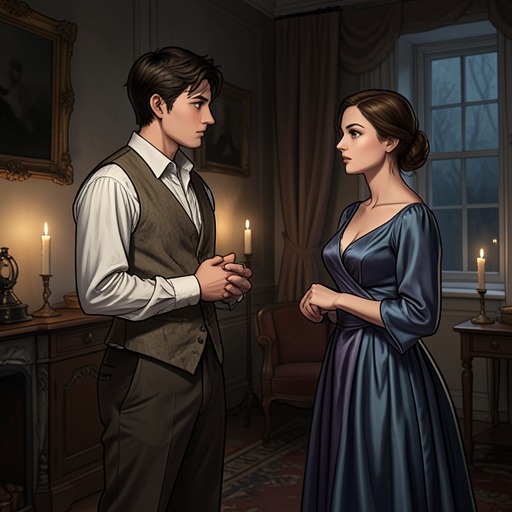
David’s idealization of Dora
David CopperfieldDavid’s idealization of Dora Spenlow is a defining feature of his first love: he elevates Dora beyond ordinary human life and lets his image of her color his perception of the world. The retrospective account preserves the intensity of that youthful devotion while also calling it foolish and insubstantial. Its significance lies in the tension between sincere feeling and limited understanding: David’s love is real, but the Dora he worships is largely a creation of his own imagination.
The Shape of the Ideal
The idealization begins at David’s first meeting with Dora in the house of Francis Spenlow. Before he has spoken with her, even her name has impressed him. Once introduced, he experiences himself as instantly captivated, with no pause for reflection. The narration makes the speed of the transformation plain: Dora becomes not simply someone David likes, but the center of a destiny he believes has overtaken him.
David’s language enlarges Dora into an almost supernatural figure. He cannot settle on what she is, describing her in terms that place her among fairies and sylphs, beyond the category of an ordinary young woman. This elevation does not arise from knowledge of her character or shared experience. It is the immediate work of infatuation, which makes Dora seem to embody everything desirable before David has learned what their relationship might require.
Love as a Refuge and a Lens
As other disappointments and troubles accumulate, David turns to Dora’s image for consolation. His attachment becomes a private refuge, and the more troubled the surrounding world appears, the more radiant Dora seems in his mind. The contrast is important: his devotion offers comfort, but it also separates Dora from ordinary circumstances and makes her less accessible as a person with her own limits and perspective.
David describes himself as saturated in love, not merely overwhelmed by it for a moment. His night walk around Norwood where David and Dora courted gives that inward preoccupation a practical form. He circles the house for hours, peers through gaps in the railings, and sends kisses toward the lit windows, imagining himself as Dora’s devoted guardian. The conduct is comic in retrospect, but it also shows how completely the ideal has taken possession of his attention: the scene is organized around his feelings, not around any conversation or mutual understanding between the two.
That same narrowing of perception governs David’s memory of an outing with Dora. The journey’s destination remains indistinct to him, and even ordinary details, including dust and the prospect Francis Spenlow asks him to notice, scarcely register. Dora, by contrast, seems to occupy the whole landscape: sun, birds, wind, and flowers all become extensions of her presence. The passage makes idealization visible as a failure of attention as well as an intensification of feeling. David sees the world, but his account shows that he is seeing it through Dora.
Courtship and the Limits of Youthful Judgment
During the outing, David’s jealousy extends even to other people of his own sex, whom he treats as rivals. A misunderstanding between him and Dora is then eased by Julia Mills, who counsels them not to let it spoil their happiness. David takes Dora’s hand and kisses it; the young couple spend the evening together, and Dora sings while David attends to her. The episode gives his idealization a social setting, but it does not yet supply the clearer knowledge of one another that his intense declarations imply.
When David finally tells Dora how he loves her, his declaration is absolute. He says that life without her love is intolerable and imagines no limit to the uniqueness or duration of his devotion. Dora cries and trembles; afterward, the two are quietly seated together, and they become engaged. Their understanding of the future remains indistinct. Dora stipulates that they must not marry without her father’s consent, but they keep the engagement secret from Francis Spenlow, and David later recognizes that, in their excitement, he did not consider the dishonor in concealing it.
The engagement preserves the gap between the scale of David’s feelings and the couple’s practical judgment. He remembers their time as happy, but also idle, foolish, and insubstantial. Even the ring he orders, a small toy set with blue stones and associated in memory with Dora’s hand, carries both meanings. Years later, seeing a similar ring on his daughter’s finger briefly stirs pain. The object links the youthful romance to the narrator’s later life, making memory itself part of the account of idealization.
Betsey Trotwood’s Warning and Retrospective Meaning
Betsey Trotwood challenges David’s confidence that intense love proves that he and Dora are suited to one another. When he insists that they love each other truly and cannot imagine either of them loving someone else, Betsey calls him blind. Her rebuke does not deny his sincerity; rather, it distinguishes sincerity from insight. She urges him to recognize that earnestness matters, while David responds by insisting on Dora’s earnestness too. Their exchange exposes how little his certainty has yet been tested by reflection.
Betsey’s caution draws additional force from her own recollection of marriage. She tells David that she has judged other people’s marital mistakes harshly and connects that judgment to painful regrets in her own life. At the same time, she refuses to intervene in a way that might divide her from David or injure their Little Blossom. Her response is therefore protective but restrained: she can identify the danger in David’s blindness without claiming power to decide his relationship for him.
The memoir’s retrospective form holds youthful rapture and later understanding together. David does not erase the happiness of loving Dora, but his own descriptions expose the fantasy within it: the beloved becomes a star above worldly trouble, a presence substituted for the world, and an absolute answer to uncertainties the young couple have scarcely considered. His remembered ecstasy is preserved, not endorsed as clear judgment. Idealization is thus both the emotional force of the courtship and the limitation that its older narrator can finally name.